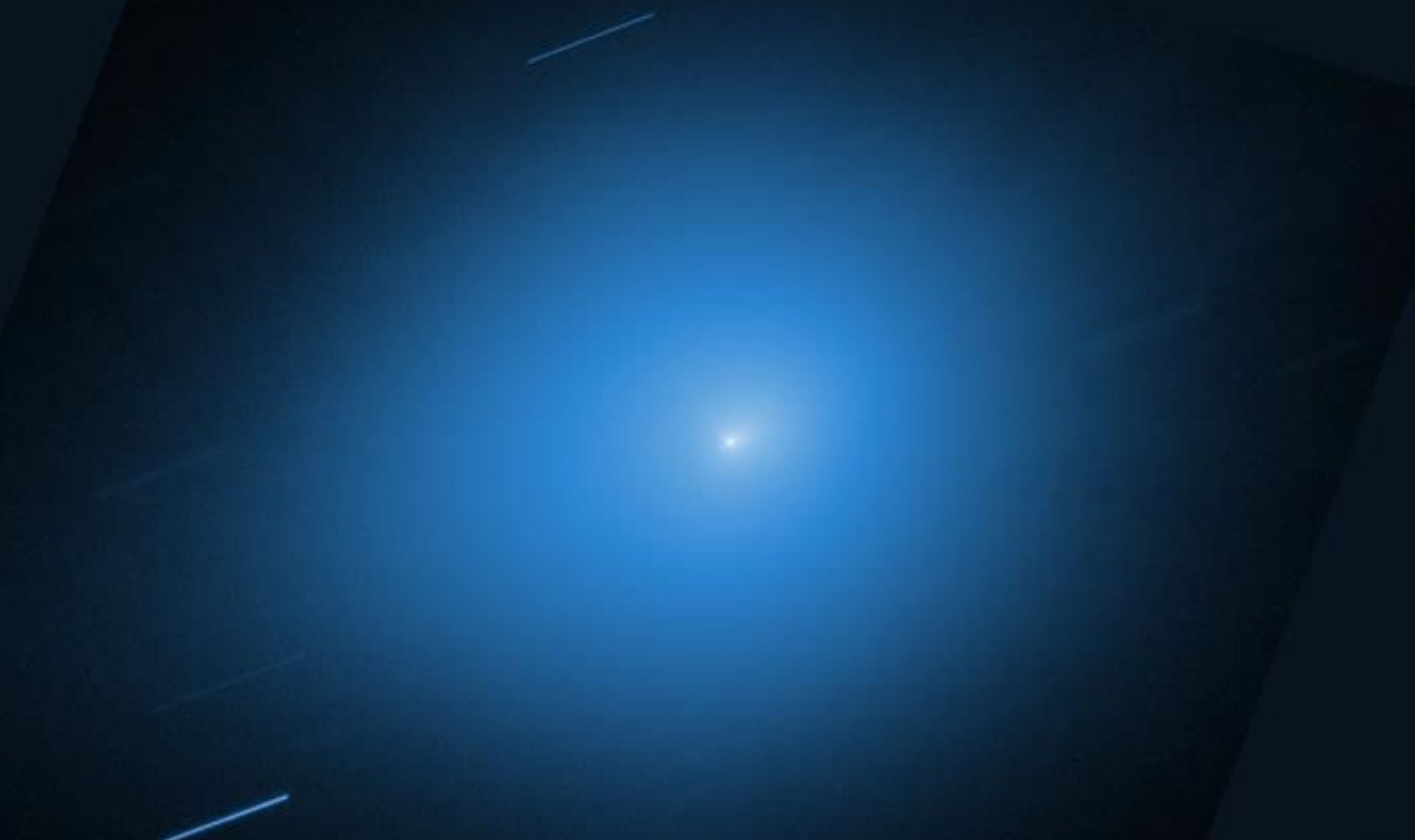

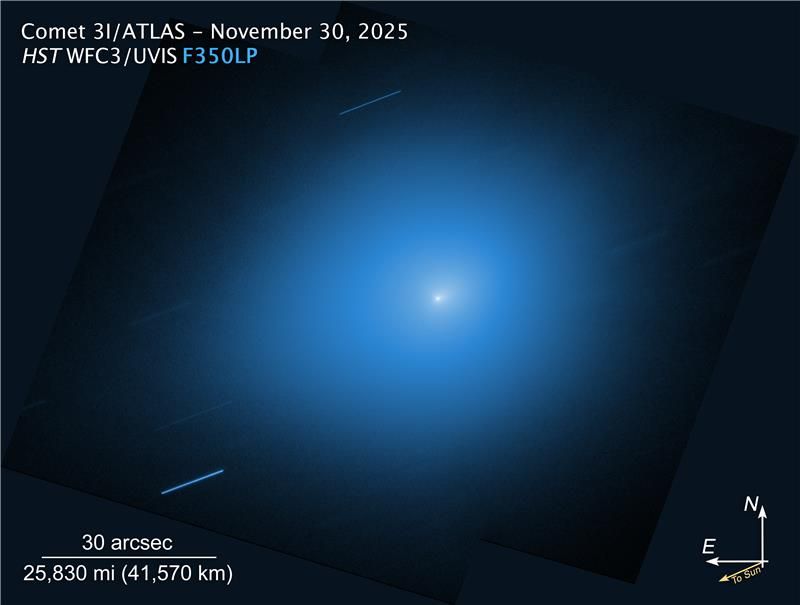
This comet, named 3I/ATLAS, is the fastest comet ever discovered, traveling through space at a speed of nearly 137,000 mph. Based on its incredible speed and trajectory, astronomers calculated that 3I/ATLAS came from another solar system.
Comets are small bodies of ice, rock, and frozen gases that are much, much smaller than planets. They have very little mass, so they tend to orbit the Sun in long, thin elliptical shapes instead of rounder, more circular paths like planets do. Because of these 'eccentric' orbits, some comets take decades or even centuries just to orbit the Sun once. 3I/ATLAS, however, does not orbit the Sun, since its high speed carried it from a distant solar system straight through ours. When comets pass close to the Sun, they begin to warm up, and their solid, icy bodies begin to release gas and dust. This is called 'outgassing', and it is the reason why comets have long tails.
Even though we know the speed and direction that 3I/ATLAS is moving, we still don't know precisely where it came from. This is because all of the nearby stars in our cosmic neighborhood are also rapidly moving through space in their own speeds and directions, just like 3I/ATLAS is. Even though nearby stars might not look like they're moving in the night sky, they are in constant motion and visibly move over extremely long periods of time, such as thousands of years. Because there are so many variables, it is extremely difficult to determine which region of the Milky Way galaxy that 3I/ATLAS came from.
Observations from the Hubble Space Telescope and the James Webb Space Telescope showed that 3I/ATLAS is actually quite similar to many of the comets in our own Solar System. It contains many of the same compounds and chemicals found in local comets, though it does have a surprisingly large amount of carbon dioxide (CO2).
Lately, there has been a lot of media buzz regarding 3I/ATLAS. At first, there was a lot of uncertainty surrounding this comet because it seems like something that shouldn't exist. We're not used to seeing mysterious objects enter our Solar System, so the notion of that might seem scary to some. But the truth is, 3I/ATLAS is just a regular, normal comet that got flung into our neck of the woods.
Before this discovery, we had only ever detected two other interstellar objects moving through our Solar System; 1I/'Oumuamua back in 2017, and 2I/Borisov back in 2019. Because these discoveries are so recent, it's not surprising that we've found a third object within the span of 10 years. It just means this kind of thing happens all the time; we just finally have the technology to see it for ourselves. We can expect to detect new objects like this every few years or so.
3I/ATLAS, being the fastest comet we've ever seen, is already long gone. It has already passed the Sun and is headed out of our Solar System. It is leaving our cosmic corner just as fast as it arrived and it will never return. We are extremely lucky that we got to wave hello to such a cool object as it passed by.